Tell us about your job and we will come back to you with an obligation free price, usually the same business day.
We reply fast. Prefer to talk? Call 0429 680 514.
Plant Equipment Hire Hobart
If you are looking for the most cost-efficient plant equipment hire Hobart has to offer, Williams Excavations is the team to call. You can utilise our large fleet of plants from well-renowned heavy equipment manufacturers. Whether you need small plants or full-size plants or plants for wet projects, we have them parked in our compound. We offer these special pieces of machinery and related equipment for hire at affordable rates.
We offer the most well-maintained and high-performing plant equipment hire Hobart residents can trust to use for excavation as well as earthmoving projects in both commercial as well as residential sites. So, no matter what your project needs, talk to us about how our complete plant hire solutions can help.
In case you don’t know how to operate them, we can also offer you trained VOC-compliant operators at reasonable charges. Our operators hold heavy vehicle licences and have gone through RII competency tests as well.
Truck Hire Hobart
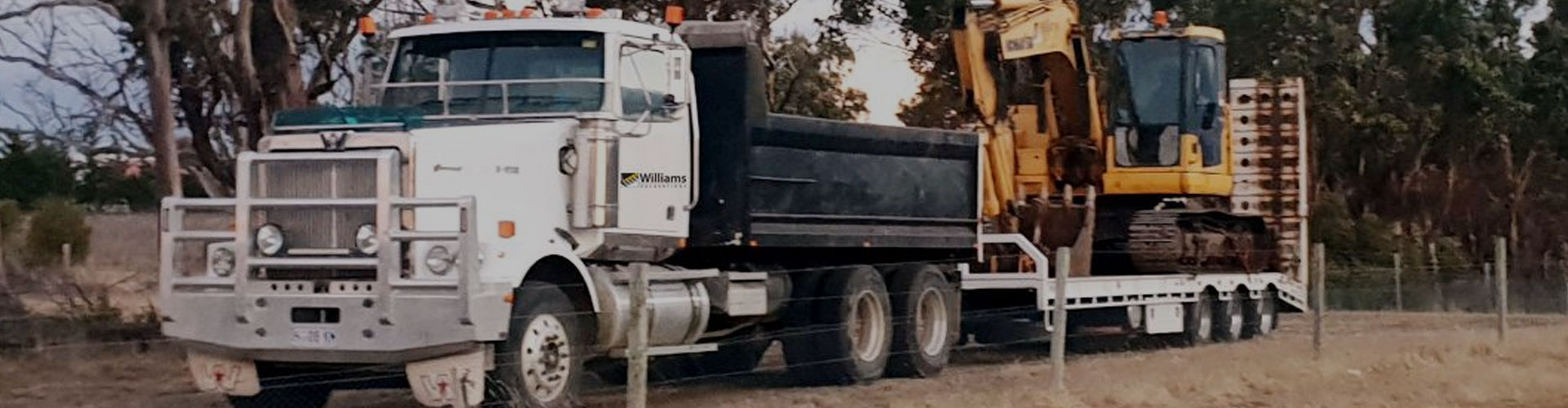
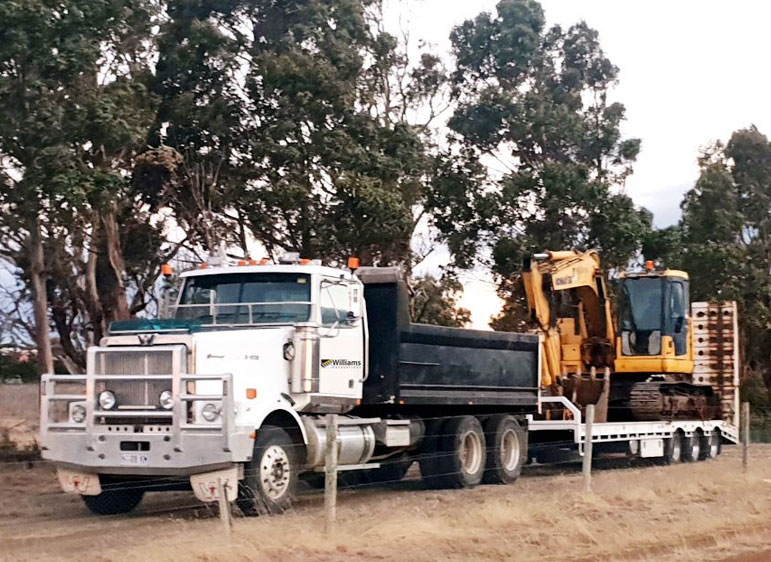
We also offer the best quality truck hire Hobart residents and use for a different purposes. Our garage has a large fleet of heavy-duty trucks that you can hire from us for small-to-large scale excavation, earthmoving, and/or construction projects at affordable rates. So whether you need a removal truck hire or a tipper truck hire, don’t hesitate to reach out to us.
We have highly trained and qualified truck operators who have years of experience, under our payroll.
Furthermore, we made sure that we are hiring equipment operators who have undergone the required industry inductions, training, and qualifications. This allows us to keep the worksites safe for our clients as well as for our team members.
Where do we offer our plant and truck hire services?
Our plant and truck hire services are available for our clients located throughout Southern Tasmania.
Why choose us?
You can gain access to our wide range of plants from well-renowned brands like –
ASV Posi-Track
Bobcat
Digga
Komatsu
Kubota
Positrak
You can choose from a wide range of options if you need plants ASAP such as –
One-Ton Excavators with 200L Buckets, 350L Buckets, 450L Buckets, 600L Buckets, Auger, Backhoes, Booms, Breakers, and Brooms
Bulldozers
Compactors
Crushers
Cutter Bars
Diggers
Drills
Elevating Scrapers
Flashers
Grabs
Graders
Grinders
Hammers
Hole Cleaners
Laser Levels
Levelling Bars
Loaders
Mini Diggers
Mini Excavators
Pallet Forks
Post Hole Diggers
Rippers
Rock Bolts
Rock Breakers
Rock Grabs
Rock Hammers
Rock Saws
Rollers
Skid Steer Loaders
Skid Steers
Spreader Bars
Stick Rakes
Trenchers
All of our plants and trucks are well maintained and we also offer on-site assistance to our clients in case our trucks or plants break down during project work. We also offer skilled operators and truck drivers at reasonable rates.
Excavation and Earthmoving in Hobart: What You Need to Know
Whether you are planning a new driveway, clearing a block for a build, or taking on a full civil construction project, excavation and earthmoving work can feel like unfamiliar territory. Most property owners only go through this process once or twice in a lifetime, so it is completely normal to have questions about cost, timing, permits, and what actually happens once the machines arrive on site.
Williams Excavations has been serving Hobart and the surrounding areas of Southern Tasmania for over 24 years, and in that time we have fielded almost every question a homeowner, builder, or developer could ask. As a proudly Tasmanian and family-owned business, we believe an informed client makes for a smoother project from start to finish. That is why we have put together this guide to the questions we hear most often, covering everything from budgeting and scheduling to permits and site conditions.
Our team operates a fleet of well-maintained modern machinery and light equipment, and we take on projects of every size and scope, from a single residential driveway to large-scale civil works and demolition. No matter how big or small the job, our approach stays the same: safe, efficient, and reliable work, delivered within budget and on time, every single time.
Below you will find detailed answers to the five questions we are asked most frequently. If you cannot find what you are looking for, our team is always happy to talk it through over the phone or during a free, no-obligation, on-site quote.
How much does excavation and earthmoving cost in Hobart?
This is, understandably, the question we are asked more than any other, and the honest answer is that it depends on your site. The size and slope of the block, the soil and rock involved, machinery access, and whether services such as water, gas, or electricity run through the work area will all affect the final price. A straightforward driveway excavation on flat, accessible ground will cost considerably less than a house site cut on a steep, rocky block with limited truck access.
Scope matters too, since some projects need only cutting and levelling, while others require cut and fill balancing, retaining structures, drainage, or spoil removal. Because so many variables come into play, we avoid quoting generic figures over the phone. Instead, we offer a free on site quote so an experienced estimator can assess your block in person and put together a detailed, transparent price based on the real conditions of your property.
02
How long does a typical excavation or earthmoving project take?
Project timelines vary just as much as costs do, and depend heavily on the scale of the job, ground conditions, weather, and how much preparatory work is needed before excavation can begin. A small residential driveway or a simple site cut for a shed might be completed within a day or two, while a full house site excavation, complete with cut and fill, drainage, and retaining work, can take a week to several weeks.
Larger civil works and subdivision projects extend further, particularly when staged approvals or service connections are involved. Weather is one of the biggest variables in Tasmania, since heavy or prolonged rain can make a site unsafe for heavy machinery, and our crews will always prioritise safety over a schedule. Once we have assessed your site, we will give you a realistic timeframe based on decades of local experience, and keep you informed if conditions require any adjustment.
03
Do I need council approval or permits before starting earthworks in Tasmania?
In many cases, yes, and this is one of the most important things to sort out before any digging begins. Whether you need a permit depends on the scale of the earthworks, whether the property sits in a bushfire or flood prone area, whether the work affects drainage on neighbouring properties, and whether it is connected to a broader development that already requires approval. Minor landscaping on a standard residential block may not need formal council sign off, while larger cut and fill works, retaining walls above a certain height, or earthworks near a boundary generally will.
Every council in Tasmania administers its own planning scheme, so requirements differ between municipalities, which is why we recommend checking directly with your local council before committing to a timeline. It is also worth arranging for underground services to be located before work begins. Approvals ultimately remain the responsibility of the property owner or their builder.
04
What should I look for when choosing an excavation and earthmoving contractor?
Choosing the right contractor makes a real difference to how smoothly your project runs. First, confirm the company is fully licensed and insured, since excavation work carries real risks to workers, property, and underground infrastructure.
Second, ask about experience with projects similar to yours, since the skills needed for a driveway differ from those needed for a complex civil works or demolition job. A contractor with a long local track record will understand typical soil conditions and council expectations in your area.
Third, look closely at how the quote is presented, since a detailed, itemised quote from an on site inspection is far more reliable than a vague phone estimate. It is also worth asking about the age of the equipment used, as well maintained machinery means fewer breakdowns and safer operation.
Finally, ask for references or read reviews, and note how responsive and transparent the contractor is from your first conversation.
05
What happens if unexpected conditions, such as rock, buried services, or wet weather, are found during the job?
Even with careful planning, ground conditions can never be predicted with complete certainty until excavation begins, and experienced contractors build flexibility into how they handle surprises. If our crew encounters solid rock where softer ground was expected, we have the equipment and experience to manage it safely, though it may affect the timeframe and cost, and we will discuss this before proceeding. Striking a buried service that was not marked is treated as a safety priority above all else, work stops immediately, and we work with you to resolve the issue.
Wet weather is a particularly common disruption in Tasmania, and heavy rain can turn a stable site unsafe almost overnight, so we will pause work until conditions allow us to continue safely and keep you updated. Throughout any of these scenarios, our priority is open communication, since we would rather explain a delay or cost adjustment clearly and early than let a client feel blindsided.
06
What is the difference between excavation, earthmoving, and civil works?
These terms are often used interchangeably, but they cover slightly different parts of a project. Excavation generally refers to the digging, cutting, and removal of soil, rock, or debris from a specific area, such as preparing a house site or digging trenches for services. Earthmoving is a broader term covering the movement, levelling, and redistribution of large volumes of material across a site, often using excavators, bobcats, and dump trucks.
Civil works generally sits above both, referring to the wider infrastructure side of a project, such as road construction, stormwater and drainage systems, retaining structures, and site works that support a subdivision or larger development. In practice, most projects involve a combination of all three, and a contractor experienced across the full range can manage a job from the first cut through to the finished, drained site.
07
What is included in a free on site quote?
A free on site quote gives us the chance to assess your property in person rather than relying on photos or a description over the phone, and it is the best way to arrive at an accurate, honest price. During the visit, one of our estimators will look at the slope, soil, and access of your site, ask what you are hoping to achieve, and identify anything that could affect scope, such as nearby services, retaining requirements, or drainage.
We will talk through the options available, explain roughly how long the project is likely to take, and answer any questions you have. You will then receive a detailed, itemised quote, so there are no vague allowances or hidden extras. There is no cost and no obligation to proceed.
08
Can you handle site preparation and land clearing for a new build?
Yes, site preparation and land clearing are among the most common projects we take on, particularly for clients getting ready to build a new home or shed. This typically involves clearing vegetation, removing trees, stumps, and debris, then cutting and levelling the site to the correct height and grade for construction. Depending on the block, it can also include cut and fill work to manage slope, drainage to redirect surface water away from the building area, and compaction of the finished pad to meet your builder’s requirements.
Because site preparation sets the foundation for everything that follows, getting it right the first time matters, and our team works closely with builders and owners to make sure the finished site meets the exact specifications needed before construction begins.
09
Do you take on both small residential jobs and larger commercial or civil projects?
We take on projects of every size, from a single residential driveway or retaining wall to large scale civil works, subdivisions, and commercial developments. Our fleet of well-maintained modern machinery allows us to scale our approach to suit the job, so a small backyard project receives the same attention to detail and safety standards as a major civil contract.
Many of our clients are homeowners undertaking a one off project, while others are builders, developers, or councils working with us across multiple jobs. Regardless of scale, our philosophy stays the same, which is to deliver safe, efficient, and reliable work within budget and on time, backed by over 24 years of experience across Hobart and Southern Tasmania.
10
What happens to the soil and material removed during excavation?
What happens to excavated soil and material depends on its condition and the needs of your project. In some cases, we can reuse suitable material on site for fill, levelling, or landscaping, reducing both cost and environmental impact. Where material is unsuitable for reuse, such as heavy clay, rock, or contaminated fill, it is removed using our truck fleet and taken to an appropriate facility for disposal or recycling in line with relevant regulations.
We will discuss the likely volume and condition of spoil during your onsite quote, since removal and disposal can be a meaningful part of the cost on larger projects. Our aim is always to manage material as efficiently and responsibly as possible, keeping unnecessary truck movements to a minimum.
Get In Touch
Contact Williams Excavations
Providing a wide range of excavation and earthmoving services throughout Southern Tasmania. Complete the form and we will be in touch as soon as possible.